Why guinea pigs grow natural bypass arteries — and how we might too
Why do guinea pigs have so many natural bypass arteries — while mice and humans have almost none?
To find out, we developed in vivo Perturb-seq for endothelial cells and used it to ask how protective collateral arteries are built. The screen was guided by that species difference: what does the guinea pig’s genome do that ours doesn’t?
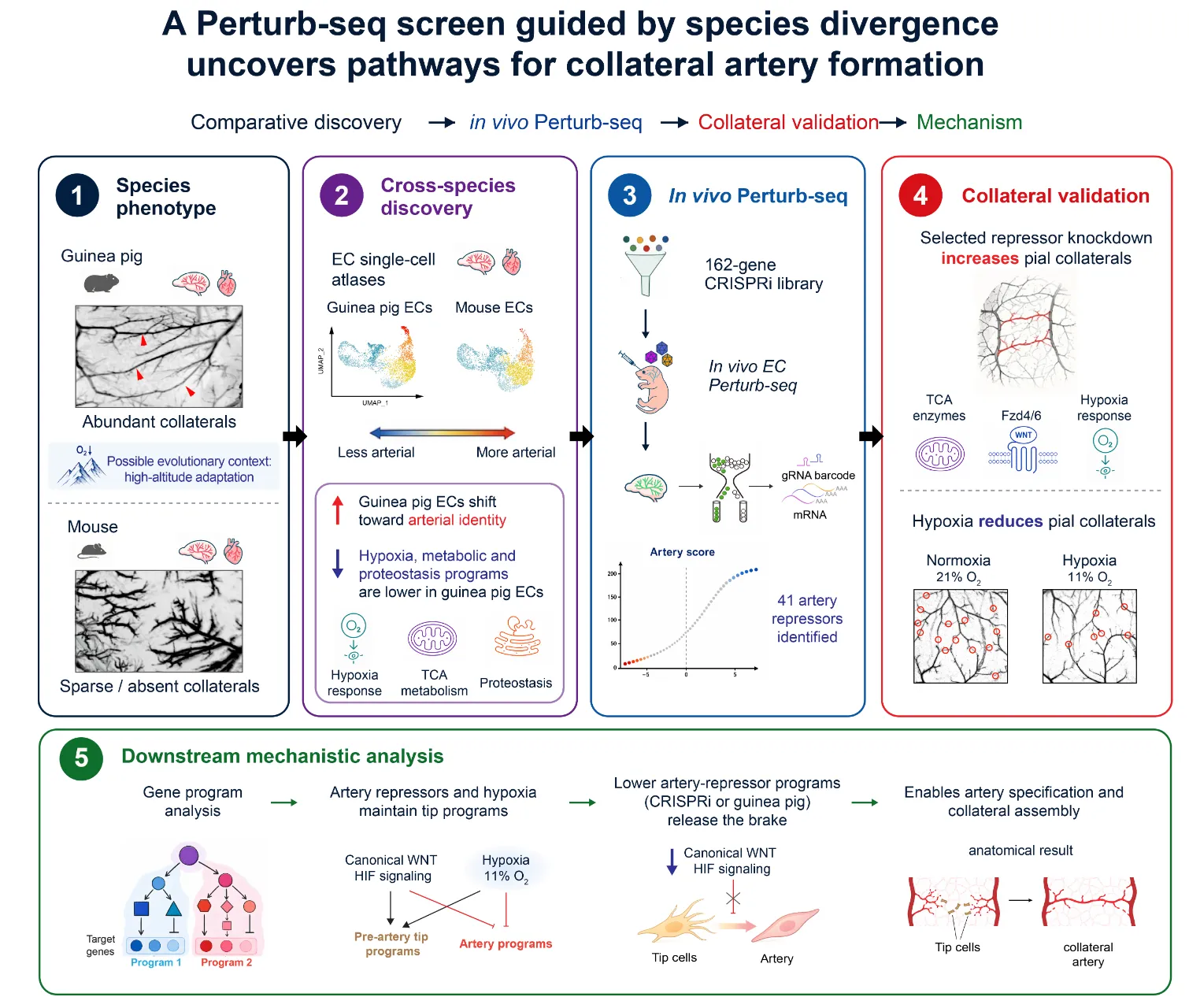
We find artery repressor pathways that appear to block a specific cell-state transition — from tip-like cells to artery-proximal capillary cells. In other words, part of what keeps humans and mice from building collateral bypass arteries may be an active brake.
That’s exciting because those pathways could be drug targets. If we could safely release the brake, growing new collateral bypass arteries might help in the context of stroke or heart attack — situations where a natural bypass is exactly what you want.
This is a preprint with Irene Fan, Ronghao Zhou, and Kristy Red-Horse.
Read the preprint on bioRxiv.