Resources
Methods and tools we built to share.
Open models, code, protocols, and datasets from the lab — for predicting enhancer–gene regulation, running CRISPR screens, and studying RNA. Everything links to the browser, repository, or paper where you can start using it.
Enhancer–gene regulation
Linking enhancers to target genes
We build computational models that predict which enhancers regulate which genes across thousands of cell types and tissues, and we host the resulting maps in interactive browsers.
- E2G Browser — explore predicted enhancer–gene links
- IGVF Catalog — variant-to-function data from the IGVF consortium
- ENCODE-rE2G model — predicts enhancer–gene links from bulk ATAC / DNase / H3K27ac / Hi-C
- scE2G model — single-cell ATAC / multiome predictions
- ABC model — the Activity-by-Contact model (see below)
Benchmarking pipelines
Related papers on the Publications page, including the ENCODE enhancer–gene encyclopedia and scE2G.
Model
Activity-by-Contact (ABC) model
The ABC model predicts enhancer–gene regulatory interactions by combining measurements of enhancer activity and 3D contact frequency. We have applied it to generate predictions across 131 cell types and tissues, with pipeline outputs, an interactive browser, and curated CRISPR validation datasets.
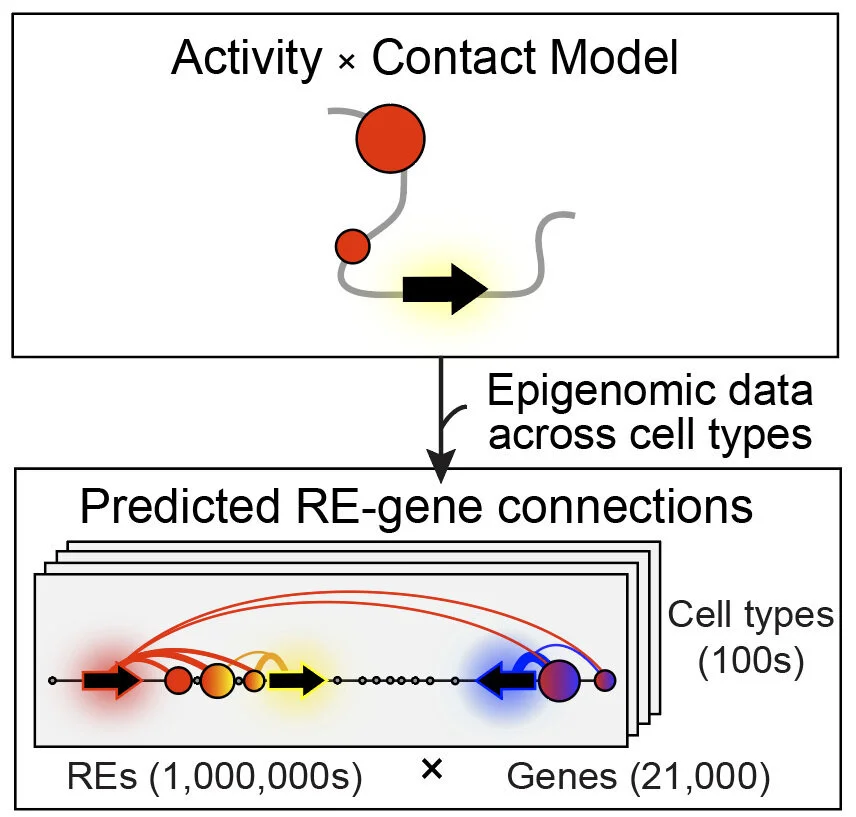
- ABC predictions browser — predictions across 131 biosamples
- ABC model code
Key papers — Fulco & Nasser et al., Nature Genetics (2019) and Nasser et al., Nature (2021). See also the Publications page.
Method
CRISPRi tiling & FlowFISH
We use CRISPR interference (CRISPRi) together with RNA FlowFISH to map how noncoding elements control gene expression at scale. Below are the plasmids, screen-design resources, and analysis code.
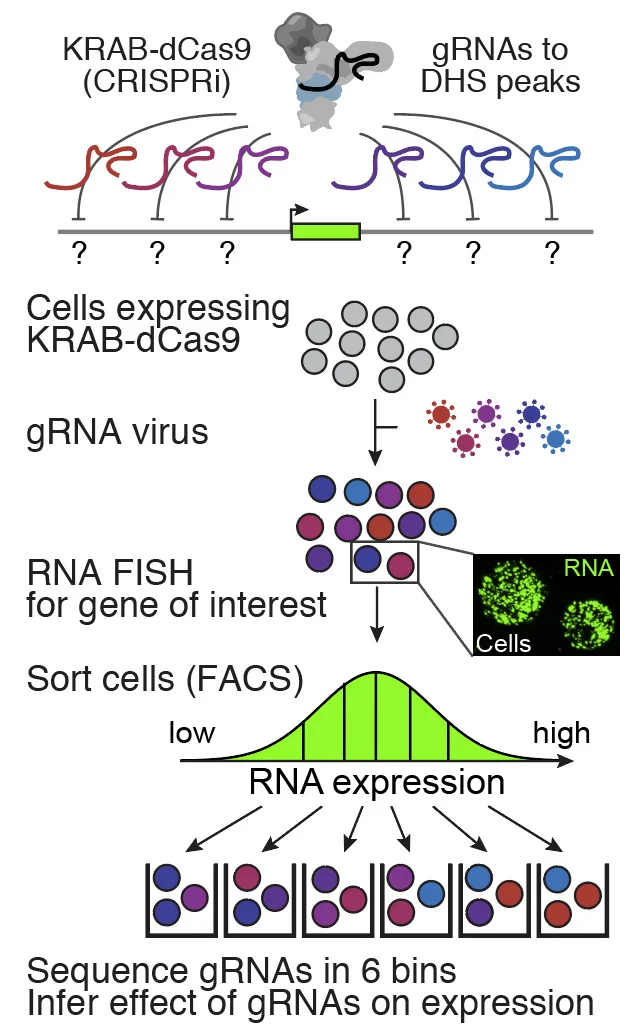
- AddGene plasmids
- CRISPR screen design checklist (Google Doc)
- CRISPRi tiling gRNA design tool
- CRISPRi-FlowFISH analysis code
Key papers — Fulco & Nasser et al., Nature Genetics (2019) and Fulco et al., Science (2016). See the Publications page.
Method
RNA Antisense Purification (RAP)
RAP is a biochemical method to identify the DNA, RNA, and proteins associated with a specific RNA of interest, developed together with the Guttman Lab.
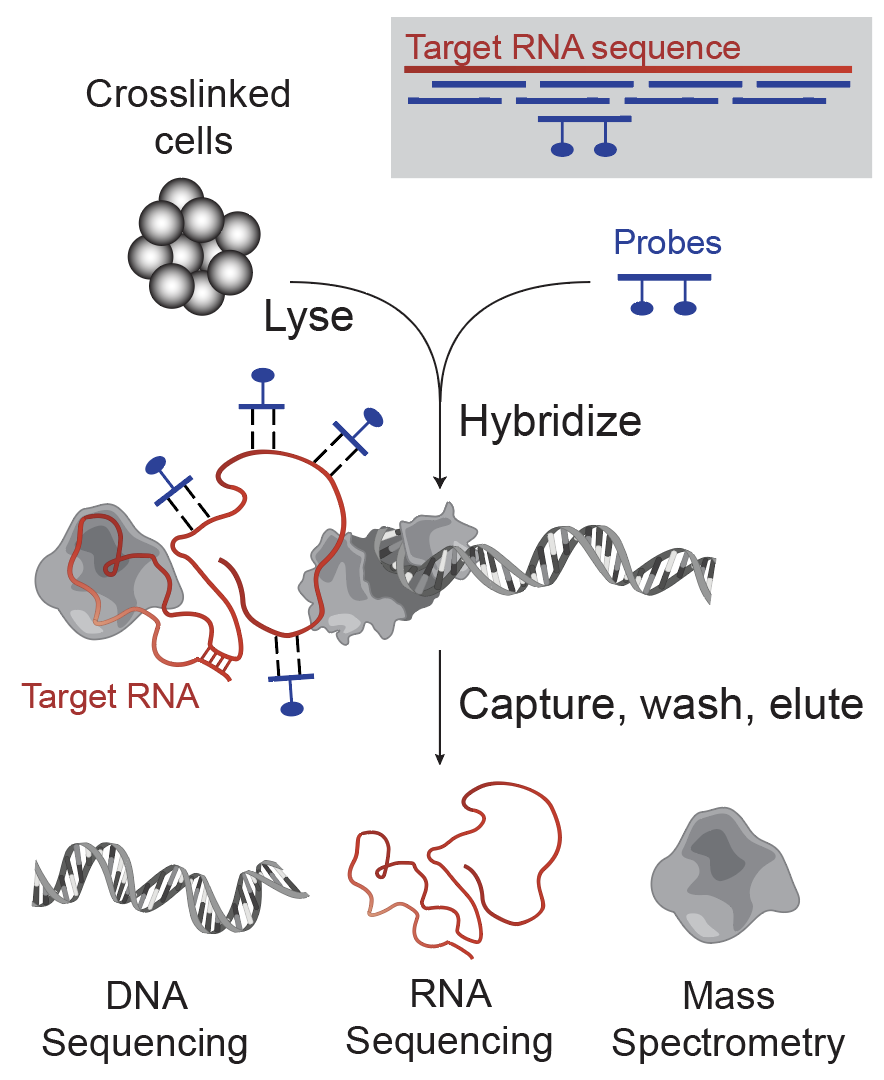
- RAP-DNA and RAP-RNA protocol (PDF)
- Probe design tool (Guttman Lab)
Key papers — Engreitz et al., Cell (2014) and Engreitz et al., Science (2013). See the Publications page.