Does every enhancer work with every promoter?
Does every enhancer work with every promoter? It’s a long-debated question — and one that matters for interpreting human genetic variants, modeling gene regulation, and designing gene therapies. Enhancer–promoter (E–P) wiring is complex and hard to predict. Together with Jesse Engreitz and Will Greenleaf, we set out to revisit it and resolve an outstanding contradiction in the field.
Does E–P compatibility play a role? We and others have used massively parallel reporter assays (MPRAs) to test thousands of E–P combinations. Yet the findings have ranged widely — from enhancers activating all promoters roughly equally, to highly specific activation of only select promoters.
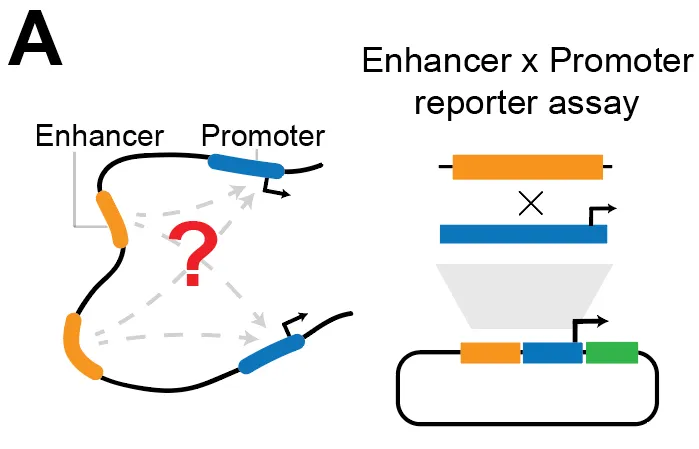
Those prior studies used different reporter designs. After some tinkering, we began to suspect that two variables were confounding the results — so we compared six designs head-to-head: do the same E–P pairs give different answers in different assays?
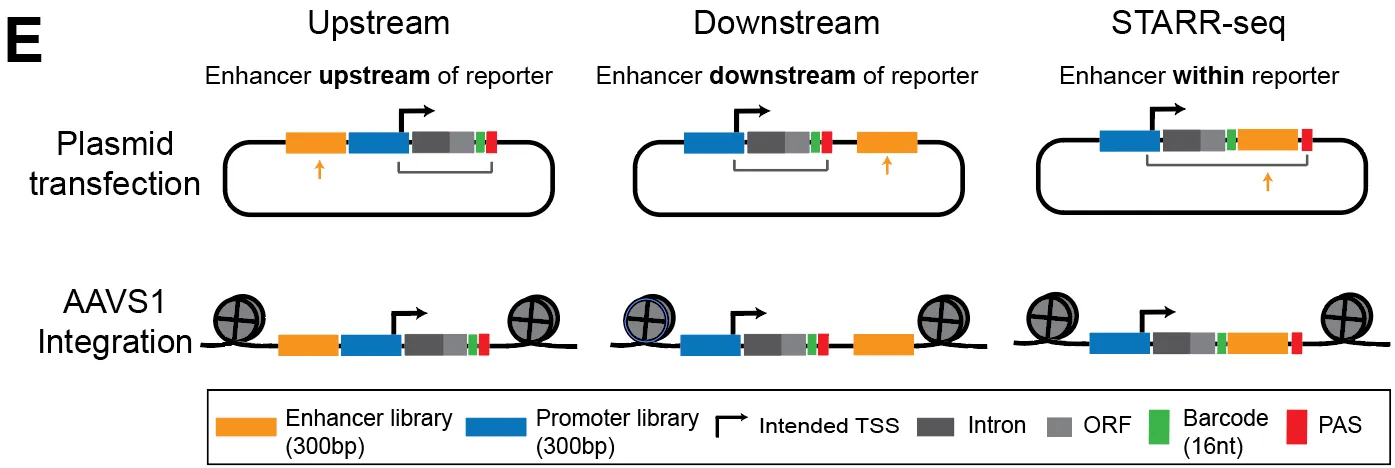
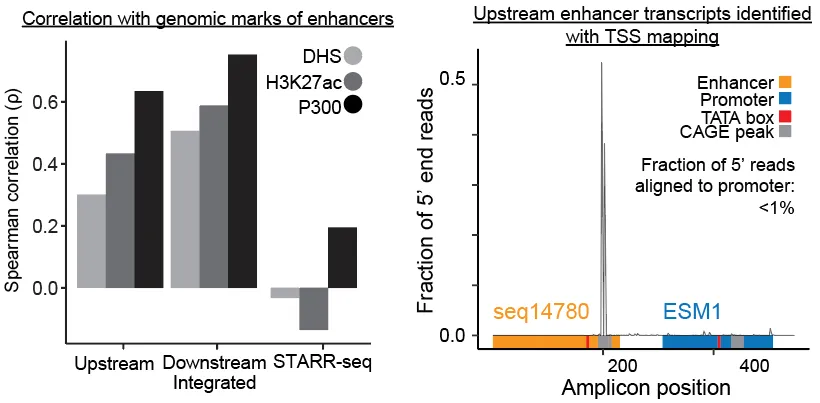
Surprisingly, yes. Confounders in the widely used upstream and STARR-seq designs distort measurements of enhancer activity — and lead to contradictory conclusions about E–P compatibility.
To cleanly re-assess compatibility, we developed improved assays and applied them across more than 25,000 E–P pairs, including seven endogenous loci backed by previous CRISPR tiling experiments.
The key finding: promoters differ dramatically in their intrinsic capacity to be activated by any enhancer — spanning more than 100-fold, from highly activatable to effectively non-activatable, versus as little as 1.1-fold at the other end. This “promoter responsiveness” scales the magnitude of activation, while the rank-order of enhancers stays largely the same.
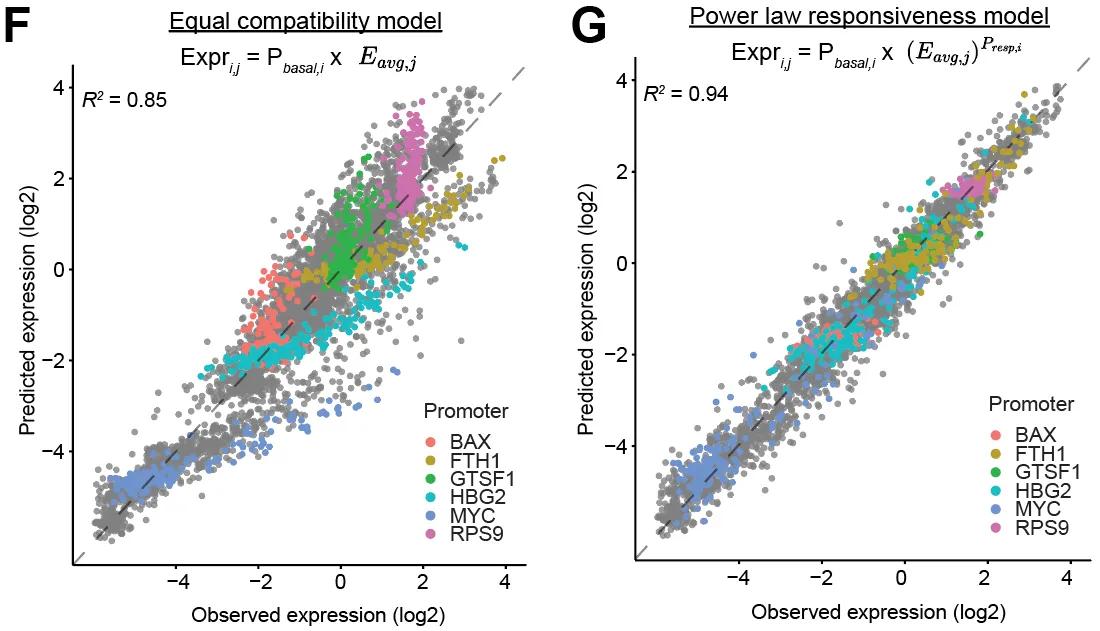
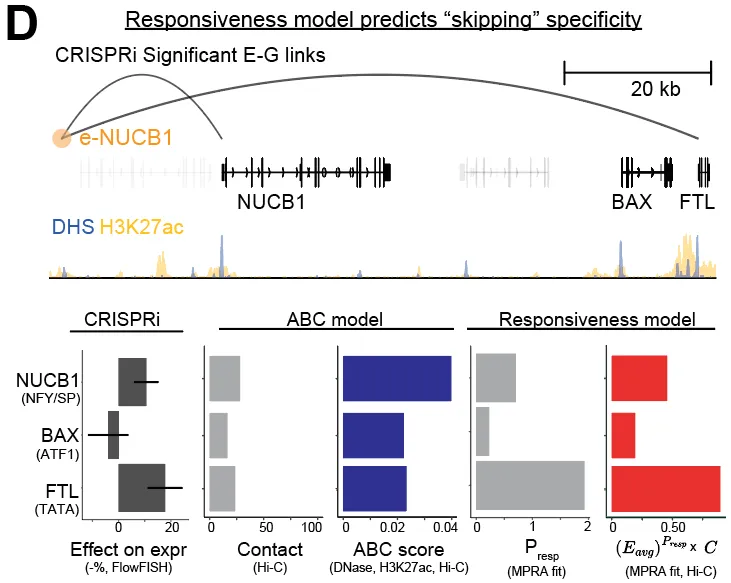
Incorporating responsiveness into the Activity-by-Contact (ABC) model improves prediction of native gene regulation — and explains two long-observed phenomena: why housekeeping genes are often insensitive to distal enhancers, and how enhancers appear to “skip” active genes. Genes with responsive promoters are regulated by more enhancers and are more sensitive to their perturbation; genes with non-responsive promoters (many of them housekeeping genes) are insensitive to, and skipped by, enhancers.
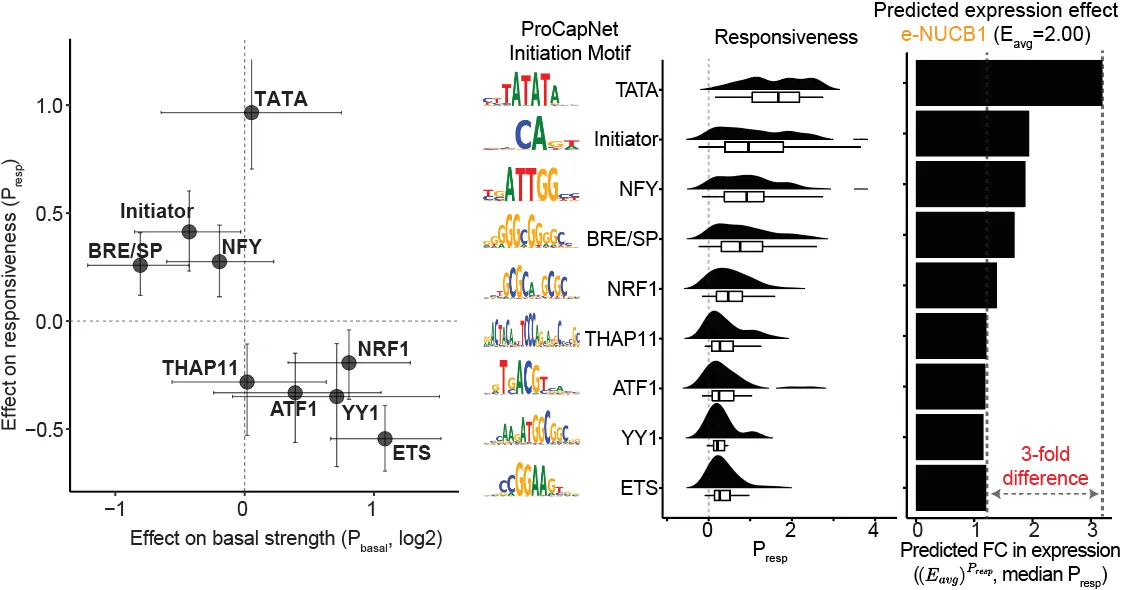
How is responsiveness encoded? Most promoters lack the classical “core promoter motifs,” yet still vary in responsiveness. Leveraging ProCapNet (from Kelly Cochran and Anshul Kundaje), we nominate several core-promoter sequence motifs associated with differential responsiveness.
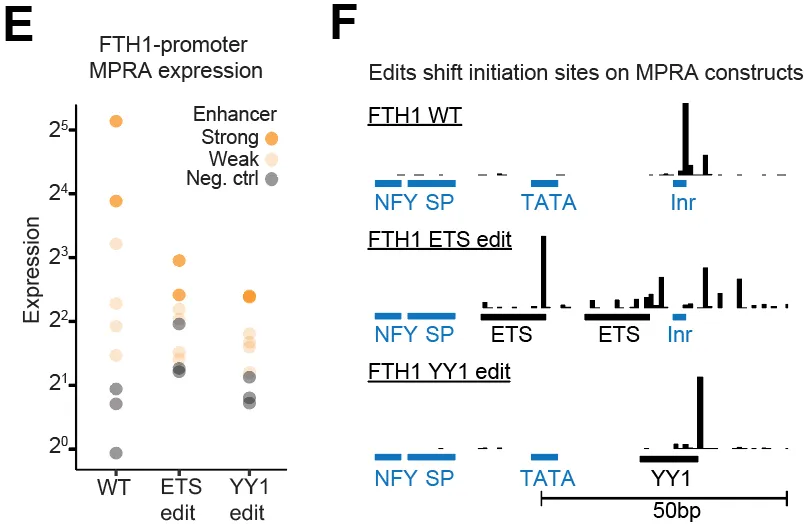
Editing those motifs modulates responsiveness in a non-intuitive way: basal activity goes up while maximum output goes down. The edits also redistribute transcription start sites, implicating recruitment or assembly of the pre-initiation complex as a possible mechanism.
Read the preprint on bioRxiv.